
The Diversity Barometer
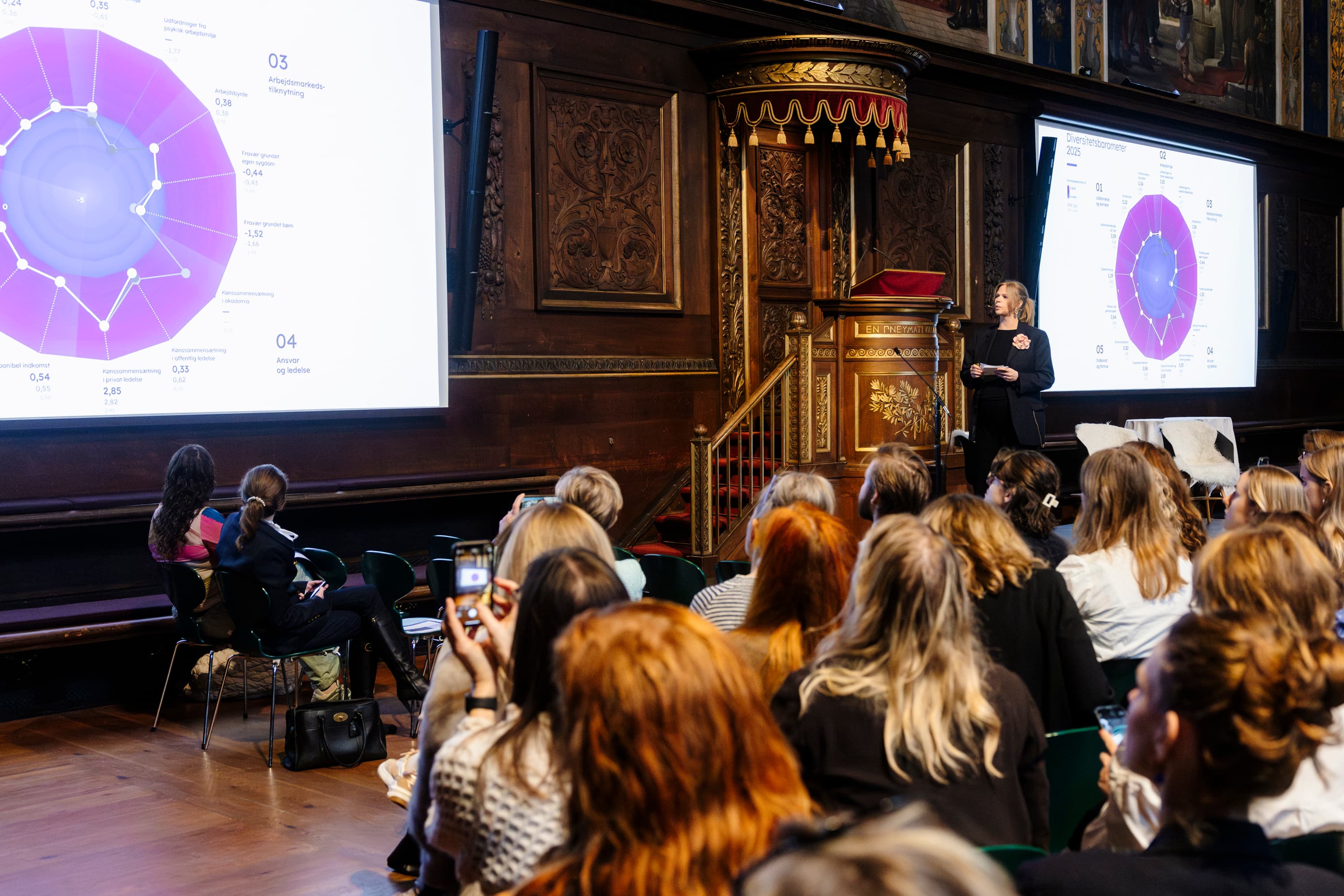
The Diversity Barometer is a measurement and monitoring tool that maps gender equality and diversity across the entire Danish labor market.
Five Themes for Gender Equality and Diversity
Based on five themes that each address gender equality and diversity in the labor market from different perspectives, the Diversity Barometer provides a comprehensive overview of the current situation.
The barometer focuses on gender representation within the themes: Education and Career, Labor Market Attachment, Work Environment, Responsibility and Management, Income and Wealth.
For each theme, the barometer indicates with an index value how close we are to achieving equal gender representation or whether there is a gender imbalance, with either women or men being overrepresented.
Chair of the EQUALIS advisory board
“We need the barometer to sling all available data right at us, so we don’t get lulled to sleep by how we think reality looks.”
Data Sources
The Diversity Barometer publication is based on three main data sources: 1) Literature and research, 2) register data, and 3) interviews and case studies of initiatives in selected companies.
Through an annual literature review, we examine research in the field of gender equality and diversity related to the labor market. We focus on a selection of research findings published since the last Diversity Barometer that illuminate and explain gender inequalities within the barometer’s five themes.
The register data come from Statistics Denmark, the National Research Center for the Working Environment, and Danish Universities. Measurement points and variables are described in the Diversity Barometer’s methodology appendix.
Based on interviews with key persons from selected companies, a series of case studies have also been developed to provide examples of good practices in the business community’s efforts to promote gender equality and diversity.

Behind the Barometer Index
The Barometer Index is based on the average values of 22 selected indicators spread across the five themes.
The indicators are converted to a scale from -5 to 5 to ensure that heterogeneous measures of gender inequality are translated onto the same scale.
A score of 0 on the index represents equal representation between men and women. Negative values indicate that women are overrepresented within the theme or subtheme described by the indicator, while positive values indicate that men are overrepresented.
Both men and women can be disadvantaged depending on whether the index score is negative or positive. Therefore, the index score should always be interpreted in the context of the specific theme.
The greater the absolute value of the index score, the larger the inequality between men and women. It is also important to note that when tracking changes over time, the key question is whether the inequality between men and women has increased or decreased. This is determined by whether the index score moves closer to or further away from 0, indicating more equal representation or greater disparity, respectively.
The Diversity Barometer 2026
Find the main conclusion from this year’s Diversity Barometer as well as the three sub-conclusions below.

Overall stability, but more setbacks than progress
The Diversity Barometer measures 22 areas. This year, we see three developments towards more equal representation and gender equality since the Diversity Barometer 2025
- Starting salary: The difference in men's and women's starting salary one year after graduation has decreased by two percentage points, from six percent to four percent.
- Maternity leave: The difference in men's and women's average number of weeks on maternity leave has decreased. Women continue to take 35 weeks, while men now take 11 weeks on average, which is two weeks more than in last year's measurement.
- Net worth: The difference between men's and women's net worth has reduced. In the Diversity Barometer 2025, men's net worth was 62 percent greater than women's and is now 57 percent greater. A decrease of five percentage points.

At the same time, the barometer shows movements away from equal representation and gender equality in five of the 22 areas
- Occupational accidents: Men report on average five percentage points more occupational accidents than women compared to last year. This means that men now report 34 percent more occupational accidents than women.
- Working hours: The difference in average working hours has increased by one hour per week. Men now work an average of five hours more per week than women.
- Public top management: The gender distribution has become less equal. The proportion of women has decreased by five percentage points from 47 percent to 42 percent. However, the distribution can still be considered equal.
- Disposable income: The difference in men's and women's disposable income has increased by two percentage points, from 24 percent to 26 percent in men's favor.
- Earned income: The difference has increased by two percentage points. Men's earned income is now 41 percent greater than women's.
The remaining 14 areas have moved by one percentage point or less. The overall picture is thus one of stability on a skewed starting point.
For example, men are still overrepresented in management positions in the private sector, where the proportion of female CEOs has fallen by one percentage point, while it has increased correspondingly at the overall management level. The difference in who works full-time is constant, women continue to have an average period of absence due to child illness more than men per year, and men's pension assets are 28 percent larger than women's, which is one percentage point lower than last year.
Sub-Conclusions
Here are the sub-conclusions from this year’s barometer.